 Lahore 18°C
 Islamabad 17°C
Pakistan Emits Less Than 1% of Global Greenhouse Gases. It's Still Drowning in the Consequences.
In 2022, a third of Pakistan disappeared underwater. Roughly 33 million people lost homes, land, or livelihoods in a matter of weeks, and the damage bill topped $30 billion. The country suffering from that flood season contributed less than 1% of the global emissions that fueled it.
That gap, between how little Pakistan pollutes and how much it pays for a warming planet, is the real story here. So how does one of the world's smallest emitters end up as one of its biggest casualties? The answer has less to do with carbon and more to do with geography, economics, and a hard truth the world is still avoiding.
A Tiny Contributor to a Massive Global Problem
Let's start with scale, because it matters.
The world's largest economies, China, the United States, the EU, and India, are responsible for the overwhelming majority of global greenhouse gas emissions. Pakistan's share, by comparison, doesn't even round up to a full 1%.
Even person by person, the average Pakistani generates only a fraction of the carbon footprint of someone living in North America or much of Europe.
That doesn't mean Pakistan emits nothing. It does. But stacked against the countries driving global warming, its contribution barely registers.
Which makes what happens next even harder to justify.
Why Geography Turned Pakistan Into Ground Zero for Climate Change
If the countries emitting the most carbon were also the ones suffering the most, Pakistan wouldn't be in this conversation at all.
Instead, its geography has put it directly in the path of climate change's worst effects.
In the north, Pakistan holds one of the largest concentrations of glaciers found anywhere outside the Arctic and Antarctica. The country is home to the world's third- and fifth-largest non-polar glaciers, Biafo and Baltoro, respectively. These glaciers aren't just scenery, they feed the Indus River, the lifeline that provides drinking water, irrigation, and electricity to millions of people.
As global temperatures climb, those glaciers are melting faster than they should. In the short term, that means more flooding. In the long term, it means the water supply millions of people depend on is quietly running out.
Then there's the monsoon, which has sustained Pakistani agriculture for generations. Climate change is throwing its timing and intensity into chaos. Some regions are left parched for far too long. Others get slammed with more rain in a few days than they would normally see in weeks.
It's a system built for balance, and that balance is breaking down.
The Year One Third of the Country Went Underwater
If there was ever a moment that made Pakistan's climate vulnerability impossible to ignore, it was 2022.
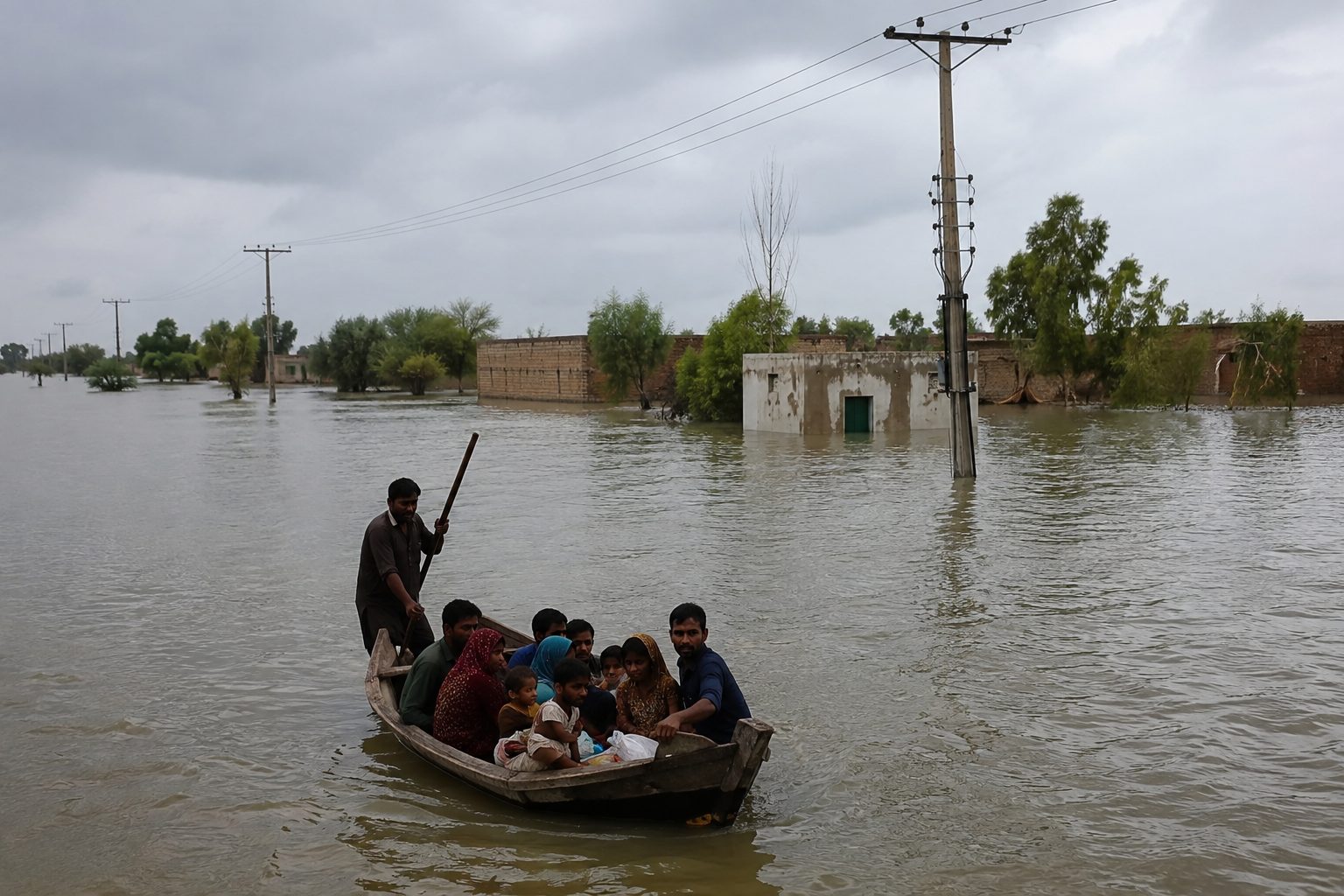
Relentless monsoon rains collided with accelerated glacier melt and triggered floods that submerged nearly a third of the entire country. Roughly 33 million people were affected. Damages and economic losses topped $30 billion, according to the World Bank.
Entire villages vanished. Roads, hospitals, schools, and farmland were washed away in days.
For millions of people, climate change stopped being something discussed in headlines and international summits. It became a humanitarian catastrophe playing out in their own homes.
Floods Are Only Part of the Story
When people picture climate change in Pakistan, floods usually come to mind first. But that's only one chapter.
The country is also living through longer, more brutal heatwaves, shrinking freshwater supplies, droughts hitting multiple regions, and steadily falling agricultural output.
That last point matters more than it might seem. Agriculture supports millions of livelihoods across Pakistan. Every failed harvest doesn't just hurt farmers, it ripples outward into food prices, jobs, exports, and household incomes nationwide. The World Bank estimates that Pakistan’s GDP can be reduced by 18% to 20$ by the year 20250.
If the Problem Is Known, Why Isn't Pakistan Just Adapting?
It's a fair question, and the honest answer isn't a lack of knowledge. It's a lack of money.
Flood barriers, modern drainage systems, climate resilient roads, efficient irrigation, and early warning systems all sound simple on paper. In practice, they require billions of dollars that wealthier nations can draw on but developing countries often can't.
Developed countries generally have the financial cushion to absorb climate disasters and rebuild stronger. Countries like Pakistan face the exact same threats with a fraction of the resources. Closing that gap will require substantial, sustained investment in climate resilience for years to come.
The Uncomfortable Question the World Still Hasn't Answered
Pakistan's situation lays bare one of the deepest inequalities of the climate crisis. The nations that contributed the least to global warming are often the ones absorbing the worst of its consequences.
This imbalance is exactly what's fueling growing calls for climate justice worldwide, with vulnerable countries arguing that the nations responsible for the bulk of historical emissions should be doing far more to fund adaptation and recovery elsewhere. It's a debate that's likely to shape international climate policy for decades.
The Bottom Line
Climate change was never only about who emits the most carbon. It's just as much about who is most exposed to its effects, and who has the least ability to recover when disaster hits.
Pakistan's glaciers are melting. Its summers are getting more dangerous. Its floods are growing more destructive. Its farmers are facing a future they can no longer predict.
And through all of it, the country is responsible for less than one percent of the emissions causing the damage.
Maybe that's the hardest lesson in all of this. Climate change doesn't always punish those who caused it. Often, it punishes those who could least afford to be in its way.