 Lahore 18°C
When the System Collapses, Society Suffers
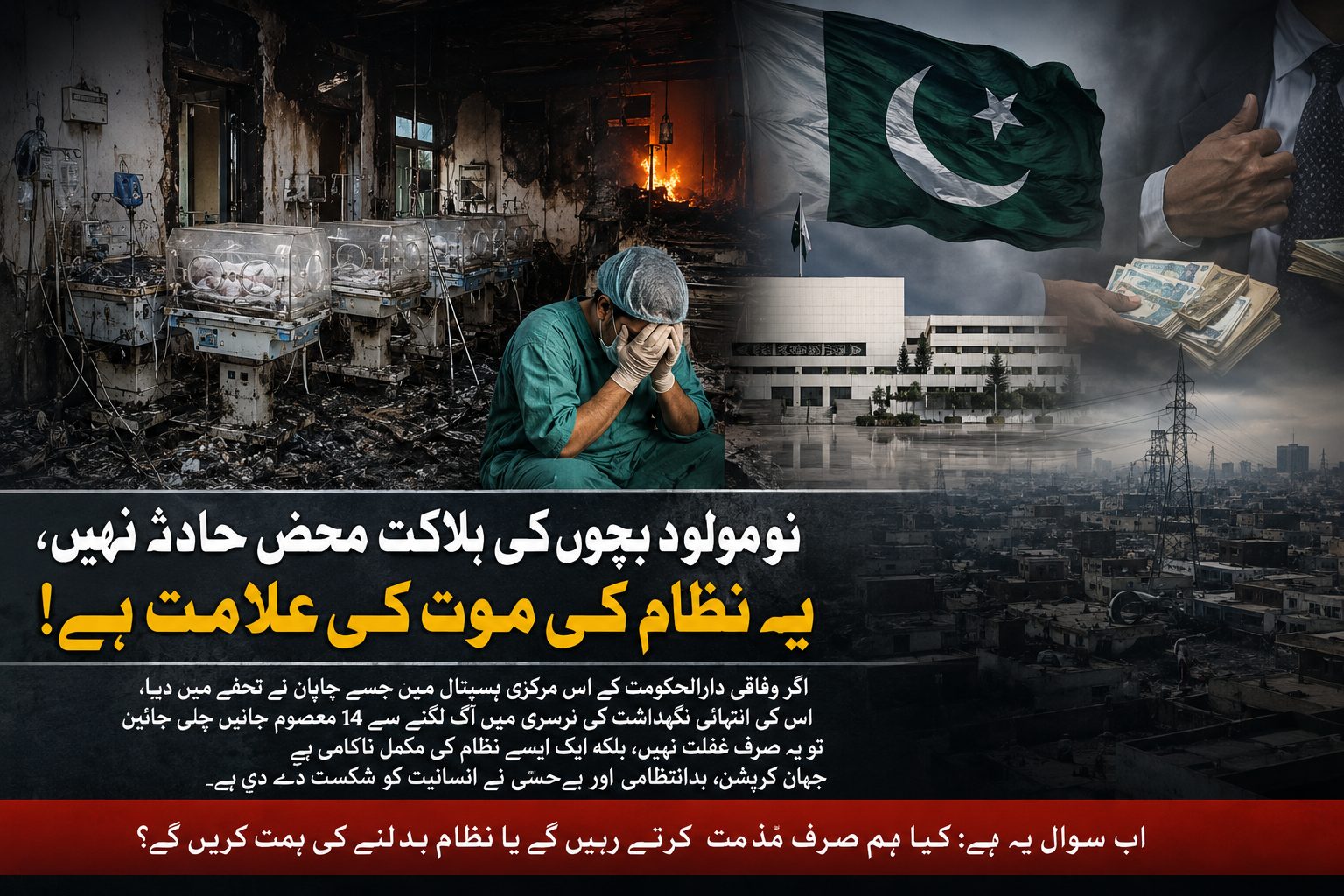
If there is no remote or underdeveloped district, no small town or village, but the federal capital itself—where a major government hospital has a dedicated children’s block, built with Japanese assistance—then a tragedy inside its neonatal nursery should force an entire nation to stop and ask: How did we get here?
If a fire in a neonatal nursery, reportedly designated as an intensive-care facility, results in the deaths of fourteen newborn babies, then the tragedy cannot simply be dismissed as an unfortunate incident. It demands accountability, investigation and an honest examination of the institutions responsible for protecting the most vulnerable.
I have many disagreements with Mohsin Naqvi, but I find myself compelled to agree with one observation attributed to him: the system has collapsed.
And it is not merely the system that appears to be failing. The social fabric itself has become so damaged and tangled that repairing it seems increasingly difficult.
The world can provide us with hospitals, buildings, technology, machinery and financial assistance. But no country can manufacture our sense of responsibility, ethics, civility and professional integrity for us. Those qualities must be developed from within society—and sadly, they appear to be in increasingly short supply.
From infant formula to life-saving medicines, allegations of adulteration and malpractice continue to raise serious questions. If decades have passed without effectively eliminating bribery, nepotism and corruption, can that not reasonably be described as institutional failure?
When a citizen approaches a government office and finds that a senior official—or even a clerk—is unwilling to perform a basic duty or speak respectfully, what else should we call it?
And when a doctor in a public hospital fails to provide the care a patient desperately needs, the consequences can become a matter of life and death. A country where citizens fear institutions that are supposed to protect them inevitably raises questions about public trust, investment and the quality of governance.
This is also a system in which political leaders often appear constrained by forces beyond elected institutions; where the poor can see their homes demolished as “illegal” while powerful interests develop enormous housing projects and towers; and where political discourse can become dominated by praise of powerful institutions rather than debate over public policy.
The ordinary citizen faces another reality. Despite extensive surveillance and CCTV cameras, checkpoints remain common. People struggle with prolonged power outages while facing enormous electricity bills. Fuel prices place additional pressure on household budgets. Industries close, businesses struggle and multinational companies reconsider their presence in the country.
For many families, the question is no longer how to improve their standard of living, but how to survive.
So perhaps the argument that “the system has collapsed” no longer sounds exaggerated.
But that brings us to the most important question: What kind of new system do we actually need?
Certainly not one that merely divides the country into more administrative units, concentrates power in the hands of one individual and leaves the underlying problems untouched.
Pakistan needs a system in which the Constitution and law prevail. A system in which merit replaces nepotism, accountability replaces impunity, and honesty is valued more than political loyalty.
Hospitals should appoint healers, not merely powerful or influential individuals. Schools should teach children practical skills, critical thinking, ethics and responsible citizenship rather than forcing them to memorize distorted or politically convenient versions of history.
Educational and religious institutions must become places where children are protected, respected and educated.
And religious education should not simply focus on rituals or methods of seeking forgiveness. It should teach people how to live honestly, treat others with dignity, fulfill their responsibilities and understand that worship does not end at the door of a mosque—it begins when a person walks back into society.
Other successful societies did not reach the heights of development merely by constructing impressive buildings. They invested in institutions, education, skills, ethics, accountability and human dignity.
Pakistan can do the same.
The choice is ultimately ours: continue repairing the visible cracks while ignoring the foundations, or rebuild the system around constitutional rule, merit, accountability, competence, ethics and respect for human life.
The tragedy of fourteen newborns should not become just another headline that disappears after a few days.
It should become a national question:
If our institutions cannot protect newborn children, what exactly are they protecting—and for whom?