 Lahore 20°C
 Karachi 25°C
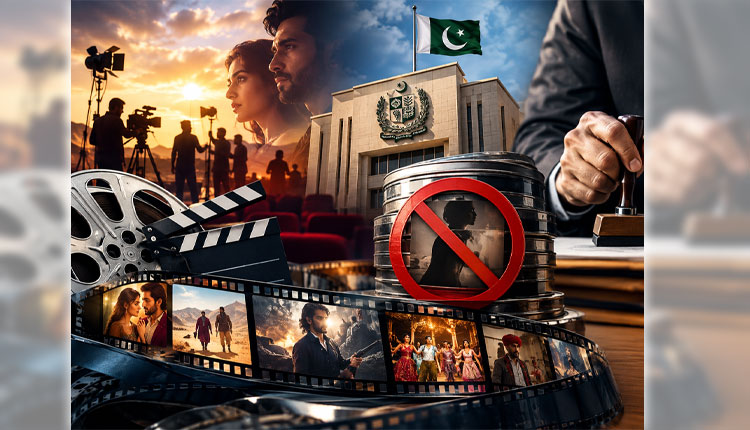
Did you know that Pakistan has an institution known as the Central Board of Film Censors, headed by a senior Grade-20 officer and supported by a sizeable team and several departments?
Among the fundamental objectives of the Central Board of Film Censors is to prevent films from containing scenes, dialogues, or content that violate prevailing moral standards and social values. It is also meant to discourage the glorification of crime and wrongdoing, as well as content that hurts the feelings of any section of society or goes against national aspirations and sentiments.
Pakistan’s film and cinema industry has, by and large, collapsed. In the early days, when filmmakers and writers created films based on their own ideas, Pakistan’s relatively small film industry was still able to compete strongly with India. Our films had stories, emotions and acting. Indian cinema had greater freedom to portray dance and certain forms of entertainment that Pakistani filmmakers did not have.
Pakistani filmmakers struggled for greater creative freedom, but once they began blindly imitating the Indian film industry while distancing themselves from their own cultural values, the industry started to decline.
Our filmmakers failed to understand that while films require budgets, good acting, strong dialogue and entertainment, the most important element is the central idea — something that comes from creativity.
Iran, for example, has produced films such as Bab'Aziz that were made on remarkably modest budgets. The film revolves around only a handful of characters travelling through the desert. There were no expensive sets or elaborate production requirements. Yet many Iranian films have captivated audiences purely through the strength of their stories.
Turkey has also recently produced dramas that have been widely appreciated by millions of viewers without relying on excessive exposure or sensationalism.
In Pakistan, Urdu films were once widely accepted. Later, however, Punjabi and Pashto films increasingly began to be produced according to the demands of cinema owners. Space for creativity and diversity gradually disappeared.
A particular formula emerged: a handsome man and woman in their thirties or forties, a few gangsters, eight or ten fight scenes, ten or twelve songs and dances — and, if the budget allowed, the police would also be brought into the story. That was essentially the formula around which the film had to be built.
This raises an important question: Where were the government and the censor board?
Film is not merely a source of entertainment. It is also a powerful medium for education, the promotion of a national narrative and a major economic activity. India’s film industry provides employment to thousands of people and generates billions of rupees in economic activity. What happened to Pakistan’s film industry?
There is currently considerable discussion on Pashto social media about the continued stereotyping of Pashtuns in Urdu dramas, where they are frequently portrayed as uneducated people, watchmen or terrorists.
On the other hand, the way Pashtuns themselves are portrayed in some Pashto films is, even in the mildest terms, an insult to the performing arts. Films and dramas continue to be produced that appear contrary to ordinary moral standards, social values and even the stated objectives of the Central Board of Film Censors — yet the censor board seems nowhere to be seen.
Supporting the creation of quality films is also among the responsibilities of the government, particularly the Ministry of Information and Broadcasting.
Encouraging filmmakers to produce meaningful and quality cinema is not an impossible task. It requires proper planning, attention, and an understanding of the importance of art and culture.
The role of a censor board should not be limited to policing — merely approving or rejecting films. Institutions should also help facilitate the creation of quality productions.
But here, even the policing function appears to have come to a standstill.
The competence and effectiveness of Central Board of Film Censors Chairman Shahab Hamid and the entire Ministry of Information and Broadcasting are now under scrutiny.