 Lahore 18°C
 Karachi 26°C
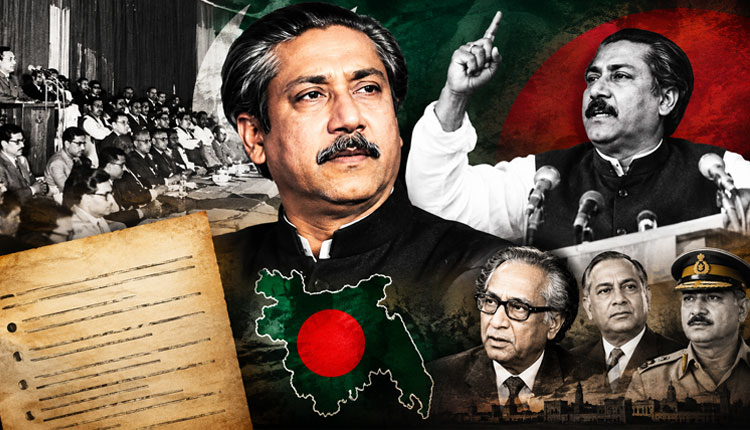
Before the partition of the subcontinent, Mujibur Rahman was a student leader and participated in the Muslim League movement for Pakistan. Later, he served as a deputy to Huseyn Shaheed Suhrawardy in the Awami League.
In 1966, a convention was held in Lahore where voices were raised against Field Marshal Ayub Khan. The convener of the convention was Nawabzada Nasrullah Khan. Sheikh Mujibur Rahman also attended the convention, and it was here, for the first time, that the famous Six Points were presented.
According to various sources, Mujibur Rahman was not the original author of the Six Points. Instead, it has been suggested that they were prepared by a civil servant from West Pakistan. The name of Altaf Gauhar has also been mentioned in connection with the drafting of the document.
There is no need to go into the entire controversy over its authorship here. What is sufficient to note is that some civil servants in East Pakistan may have participated in developing the idea because they believed that even if East Pakistan did not achieve independence, it should at least be granted maximum autonomy.
The language of the draft was such that leaders of the Awami League, Sheikh Mujibur Rahman, or others associated with him, who were not particularly skilled in drafting such documents, would allegedly have found it difficult to write it without assistance from someone in West Pakistan.
An important point is that the concept had emerged before the 1966 Lahore Convention. Before the convention, a copy of the Six Points was reportedly sent to Nurul Amin, a leader of the Pakistan Democratic Party. He showed the draft to another party member, Mahmood Ali. Both reportedly agreed that the document contained the seeds of separation and that they could not support it.
Mahmood Ali and Nurul Amin believed that the copy had been sent only to them. However, they were surprised when Sheikh Mujibur Rahman produced the Six-Point document at the convention.
Everyone was reportedly surprised because the language of the draft was the same as that contained in the copy received by Nurul Amin. The document had been sent to them in Dhaka, and the same text was subsequently presented as the Six Points.
The Six Points
Point One
According to the Lahore Resolution, the Constitution should provide a genuine federation, based on parliamentary government, the supremacy of a legislature elected through adult franchise, and a true federal structure.
Point Two
The federal government would retain only two departments—defence and foreign affairs—while all other departments would be transferred to the constituent units of the federation.
Point Three
There should be two separate but freely convertible currencies for the two wings of the country. Alternatively, a single currency could be retained for the entire country, but effective constitutional provisions would be required to prevent the transfer of currency from East Pakistan to West Pakistan.
A separate banking reserve should also be established for East Pakistan.