 Lahore 21°C
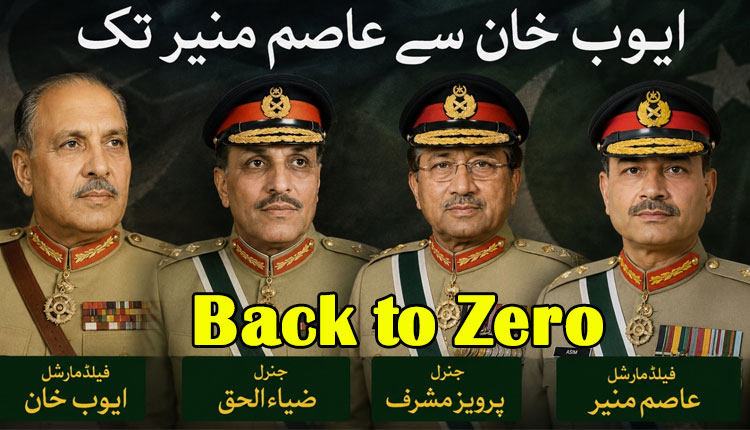
After imposing martial law on October 7, 1958, and forcing President Iskander Mirza to resign and leave the country on October 27, 1958, the political Field Marshal and Chief Martial Law Administrator suspended the Constitution and banned political parties. The Constitution was suspended, politicians were arrested, and a new system was introduced in the name of reforming the political system.
A highly controversial law, the Elected Bodies Disqualification Ordinance (EBDO), was introduced. It was applied to politicians on allegations of corruption, misconduct and political wrongdoing. In an effort to cleanse the national leadership of politics, the Basic Democracies, or BD system, was introduced in 1960.
Under this system, representatives were elected from each electoral constituency and were designated as the Electoral College for the election of the President. President Ayub Khan was subsequently elected to the office of President through the votes of these representatives. Although representation was given to these individuals at the public level, President Ayub concentrated the full powers of the state in his own hands, leaving these representatives with little more than a ceremonial role.
On the night of July 5, 1977, General Zia-ul-Haq struck against the democratic system at a time when a nine-party opposition alliance, known as the Nine Stars, and Zulfikar Ali Bhutto had reached an agreement that was scheduled to be signed on the morning of July 6. Prime Minister Zulfikar Ali Bhutto was arrested and a promise was made to hold new elections within 90 days after reforms. However, those 90 days eventually stretched into 11 years.
This became the longest martial law in the country’s history. Once again, the democratic system was declared a failure, a non-party political system was introduced, and various experiments were carried out in the name of Islamization. A non-party Majlis-e-Shura, or parliament, was established, while General Zia-ul-Haq concentrated complete powers in his own hands.
Much can be written about Zia-ul-Haq’s measures. But if the question is whether you want the implementation of an Islamic system in the country and your answer is yes, then it meant that you had elected President Zia-ul-Haq for another five-year term. After using a controversial referendum to secure a second term as president, Zia-ul-Haq’s era saw the country sink into political, moral and social decline, along with incompetence, the destruction of educational standards, hypocrisy and terrorism. Pakistan has still not been able to emerge from this quagmire.
After Zia-ul-Haq was killed in a plane crash along with his fellow generals and U.S. Ambassador Arnold Raphel, the new Army Chief, General Mirza Aslam Beg, restored the democratic system, although political parties were not given complete freedom to operate. Governments continued to be dismissed after short periods of two and a half years, three years or even 18 months through Article 58(2)(b), which had been incorporated into the Constitution during Zia-ul-Haq’s rule.
Eventually, October 12, 1999, proved to be another dark day when the then Prime Minister attempted to dismiss Army General Pervez Musharraf and appoint a new Army Chief while Musharraf was returning from a foreign visit and was still in the air. However, General Musharraf’s fellow generals foiled the Prime Minister’s attempt, took control of the state television headquarters and announced the end of the Nawaz Sharif government. After General Musharraf landed in Pakistan, he was taken to the Prime Minister’s House and placed in power.
Some time later, a larger bench headed by Chief Justice of Pakistan Irshad Hasan Khan partially validated General Pervez Musharraf’s action. The ruling provided a basis for him to remain in power for three years for the stated purpose of introducing reforms and also granted the individual in power authority to make necessary constitutional amendments during that period, although Musharraf had not even sought such authority from the court.
Following the traditions of previous martial-law regimes, Pervez Musharraf also kept the Constitution in abeyance while announcing reforms to the system. A local government system was established, under which elections were held at the district level. The stated objective was to transfer power to the grassroots level instead of relying on traditional provincial governments. However, as usual, the center of power remained General Pervez Musharraf himself.
Musharraf later imposed Emergency Plus through his own cabinet to dismiss the assembly that he himself had created, rendering the Constitution ineffective. Judges who did not deliver decisions in his favor, including Chief Justice Iftikhar Muhammad Chaudhry, were placed under house arrest.
Musharraf was eventually forced to resign under pressure from his own assembly and went into exile. He became the first Pakistani general to face a case under Article 6, initiated by Prime Minister Nawaz Sharif. A three-member bench headed by Justice Seth Waqar ordered the death penalty against him. However, the sentence was never carried out, as General Musharraf died while still under conviction. Following his death, the Supreme Court also upheld the death sentence.
Although the cycle of civilian governments coming and going has continued since Musharraf, the struggle for power between Army Chiefs and civilian power holders has intensified rather than diminished.
The new Field Marshal, General Asim Munir, is credited with responding to Operation Sindoor through Marka-e-Haq and inflicting a severe defeat on India. While remaining behind the scenes, he is not only controlling the government at the domestic level but has also gained international prominence through defense agreements.
Despite this, the hunger for power does not appear to be diminishing. Now, he seems to be moving toward repeating the history of Field Marshal Ayub Khan’s era: reducing politicians to zero by dividing provinces down to the district level, establishing district governments, installing preferred chief executives and becoming the center of power and authority.
It does not seem that this country, acquired in the name of Islam, will be able to escape this cycle of the struggle for power even in the next few centuries.
Brief: A look at Pakistan’s history of military interventions, from Field Marshal Ayub Khan to General Zia-ul-Haq and General Pervez Musharraf, and concerns that the country may once again be repeating the same cycle of concentrated power and political marginalization.