 Lahore 29°C
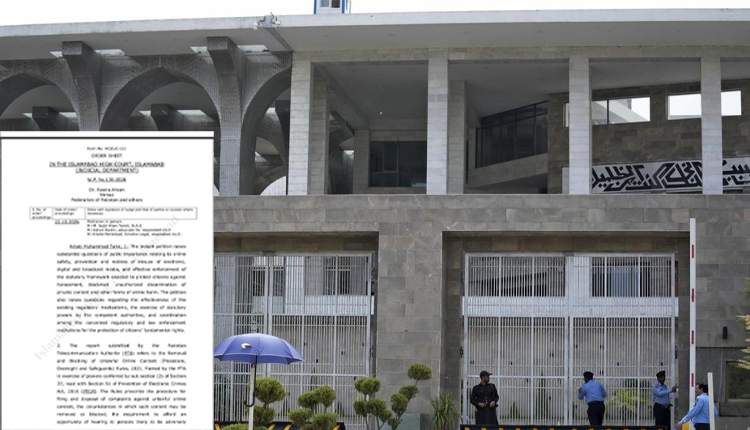
ISLAMABAD: The Islamabad High Court (IHC) has directed relevant authorities to ensure the implementation of laws aimed at preventing online harassment, blackmail and the unauthorized dissemination of private content, while seeking a comprehensive report on the measures taken in this regard.
Justice Arbab Muhammad Tahir issued the written order while hearing a petition filed by Dr. Rana Ehsan. The court emphasized the need to enforce existing laws to prevent the misuse of digital media and ensure effective redressal of complaints.
The court directed the Pakistan Telecommunication Authority (PTA), Pakistan Electronic Media Regulatory Authority (PEMRA) and National Cyber Crime Investigation Agency (NCCIA) to submit a comprehensive report.
According to the written order, a meeting should be convened involving the Ministry of Information Technology, PEMRA, PTA, NCCIA and other relevant ministries and departments to review issues related to the misuse of digital media and the prevention of online offences.
The court instructed the relevant institutions to identify legal, administrative and technical obstacles hindering implementation. They were also directed to explain the measures taken or proposed to address these challenges.
The meeting should further identify areas where coordination among the relevant institutions is required, the order stated.
The IHC also directed the authorities to provide details of the measures taken to prevent online harassment, blackmail and the unauthorized dissemination of private content. The written report submitted by the PTA has also been made part of the court order.
PTA Report Details Rates of Illegal Content Blocking
According to the PTA report, the rate of compliance with requests to block illegal content varies across different categories and social media platforms.
The report stated that the compliance rate for requests to block content related to Pakistan's defence and security stood at 59.1 per cent, while the rate for content related to terrorism was 79.51 per cent.
The PTA report further showed that 76.54 per cent of content classified as being against the sanctity of Islam was blocked, while the rate for content related to decency and morality stood at 98.91 per cent.
The blocking rate for sectarian and hate-related content was recorded at 64.43 per cent, according to the report.
Among social media platforms, the rate of content blocking stood at 48.42 per cent on Twitter, 78.57 per cent on Facebook and 79.52 per cent on Instagram.
The report stated that 87.34 per cent of the targeted content was blocked on YouTube, while the rate on TikTok stood at 88.68 per cent.
Social Media Platforms' Response to PTA Directives
The written order stated that social media companies had been asked to fulfil registration requirements with the PTA and appoint local representatives to address complaints. However, no positive response had been received.
According to the PTA, social media operators frequently reject requests to remove illegal content, creating difficulties in ensuring effective redressal of complaints.
The court's order also referred to the provision under the Prevention of Electronic Crimes Act (PECA) for the establishment of a Social Media Protection and Regulatory Authority, envisaged with extensive powers and responsibilities to remove or block illegal content.
The court raised the question of whether the competent authorities were effectively exercising the legal powers available to them under the relevant laws and rules.
It also stressed the need to assess the level of coordination among PEMRA, the PTA and the NCCIA, particularly in efforts to prevent online offences and address complaints involving the misuse of digital platforms.
The Islamabad High Court has scheduled the next hearing of the case for November 23.