 Lahore 23°C
The Rise of Convention Muslim League and the Growing Rift in East Pakistan
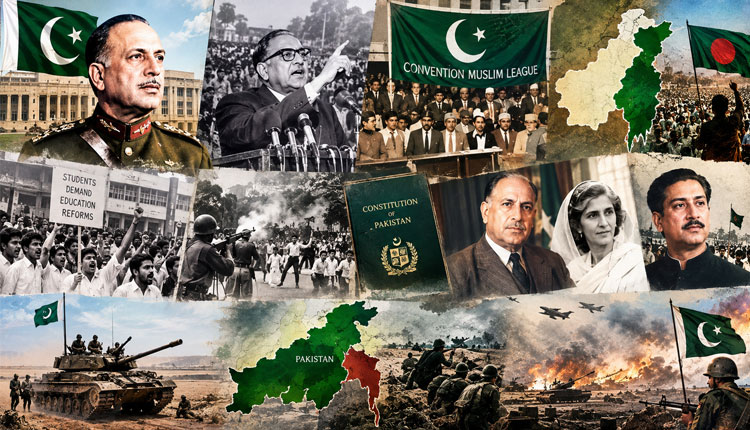
Pakistan’s political landscape underwent major changes following the introduction of the new Constitution in June 1962. The constitutional arrangement soon faced opposition, with former prime minister Huseyn Shaheed Suhrawardy leading a nationwide political campaign demanding greater democratic representation, direct elections to the legislatures and the restoration of fundamental rights.
The government initially responded to the opposition with a tough crackdown, including the arrest of Suhrawardy. His detention triggered strong public reaction, particularly in East Pakistan, where political and student activism was already gaining momentum.
Student protests soon became another major challenge for the government. Demonstrations against proposed educational reforms and the three-year degree programme intensified in East Pakistan and later spread to West Pakistan. Clashes between students and law-enforcement agencies further aggravated the situation. A province-wide strike was subsequently observed, forcing the government to reconsider and eventually withdraw the proposed three-year degree programme.
The political situation also highlighted the difficulty of running the constitutional system without organised political parties. In July 1962, the government introduced legislation allowing political parties to resume their activities, although several restrictions remained in place.
Against this backdrop, President Ayub Khan moved to establish his own political platform, the Convention Muslim League. The emergence of political parties brought renewed political activity and increased criticism of the constitutional system and the government.
The presidential election became a particularly controversial episode. Ayub Khan was declared the winner over Fatima Jinnah, despite her strong support in several urban areas. Opposition leaders rejected the result, alleging that the election had not been conducted fairly. In subsequent National and Provincial Assembly elections, the Convention Muslim League secured a commanding majority.
Ayub Khan began his second presidential term in March 1965 with substantial parliamentary support. However, political developments in East Pakistan were increasingly moving in a different direction. In 1964, Sheikh Mujibur Rahman and the Awami League advanced demands for greater regional autonomy, including proposals for separate economic arrangements and a constitutional framework inspired by the Lahore Resolution of 1940.
The political divide between the two wings of Pakistan continued to deepen. The defeat of the combined opposition in the presidential election further strengthened the view among some East Pakistani political leaders that stronger measures were needed to secure greater autonomy for the eastern wing.
Meanwhile, Ayub Khan’s plans for a period of political stability and economic development were disrupted by rising tensions with India. In April 1965, fighting broke out in the Rann of Kutch area. A ceasefire was later reached through international efforts, but the wider conflict between Pakistan and India soon intensified.
By August, renewed clashes were reported along the Kashmir front. On 6 September 1965, India launched a major offensive across Pakistan’s international border, leading to a full-scale war between the two countries. The conflict continued for 17 days before a ceasefire came into effect on 23 September following international diplomatic intervention.
The political tensions of the 1960s, combined with growing demands for democratic rights, regional autonomy and constitutional reform, would have far-reaching consequences for Pakistan. The developments of this period ultimately became an important part of the political and historical chain of events that culminated in the separation of East Pakistan in 1971.