 Lahore 23°C
 Karachi 30°C
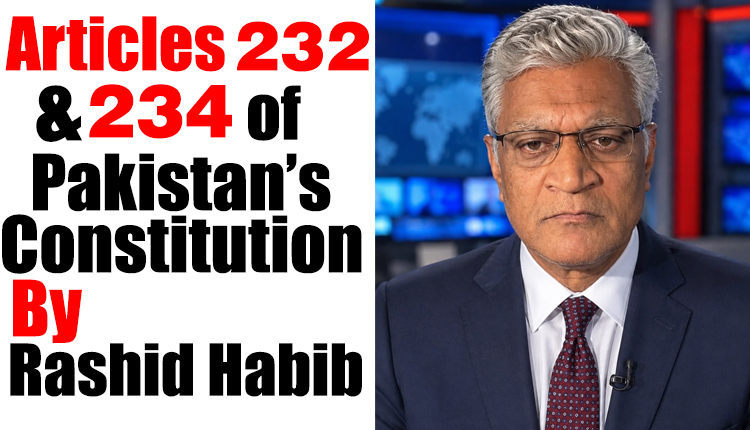
Let us understand what Articles 232 and 234 of the Constitution of Pakistan provide for, under what circumstances they can be implemented, and what their implications are.
Article 232 of the Constitution of Pakistan deals with the proclamation of an emergency in the country or any part of it. If the President of Pakistan is satisfied that the security of Pakistan or any part of the country is threatened by war, external aggression or internal disturbances, an emergency may be proclaimed.
Advice of the Prime Minister: The President of Pakistan makes such a proclamation on the advice of the Prime Minister.
Provincial Assembly Resolution: If an emergency is to be imposed in a province on the grounds of internal disturbances, a resolution passed by the relevant provincial assembly is required.
Parliamentary Approval: Following the President’s proclamation, the emergency must be placed before Parliament for approval within 10 days and must be approved by a joint sitting within 30 days. During an emergency, the federal Parliament gains the authority to legislate on provincial matters and subjects that ordinarily fall within the jurisdiction of provincial assemblies.
During an emergency, Parliament may extend the term of the National Assembly by up to one year through legislation. However, such an extension cannot continue beyond six months after the emergency has ended. The imposition of an emergency does not dissolve the government or assemblies, although they are suspended, and the Chief Minister cannot exercise their powers. The administration and control of the province are transferred to the federal government, which runs provincial affairs through its representative, the Governor. During this period, all constitutional and fundamental rights of the people of the province also remain suspended. Approval of an emergency under Article 232 by a joint sitting of Parliament is mandatory and is obtained through a resolution. The emergency can be withdrawn at any time once conditions return to normal.
Article 234 of the Constitution of Pakistan deals with the failure of constitutional machinery in a province, commonly referred to as Governor’s Rule. If the President of Pakistan, on the basis of a report from the provincial Governor or through other means, is satisfied that the provincial government cannot be carried on in accordance with the Constitution, the President may issue a proclamation under Article 234.
The President may assume all or some of the powers of the provincial government or assign them to the Governor. However, the powers of the provincial assembly cannot simply be delegated to another authority; they may instead be exercised by Parliament or under its authority. Governor’s Rule is initially imposed for two months. It requires approval by a joint sitting of both houses of Parliament—the National Assembly and the Senate—and may be extended for a maximum period of six months.
These constitutional articles serve as safeguards for extraordinary circumstances. When a province cannot be governed in accordance with the Constitution, daily life is disrupted, lawlessness and unrest escalate, the provincial government loses control of law and order, the province fails to cooperate with the federation, external threats loom, or the country is in a state of war, the President may proclaim an emergency under Article 232 across the country, in a particular province, or in a specific part of the country.
The presidential proclamation must subsequently receive parliamentary approval. The provision may also be invoked following a resolution passed by the provincial assembly. If the provincial assembly does not pass such a resolution, approval of the presidential proclamation may be sought from a joint sitting of Parliament.
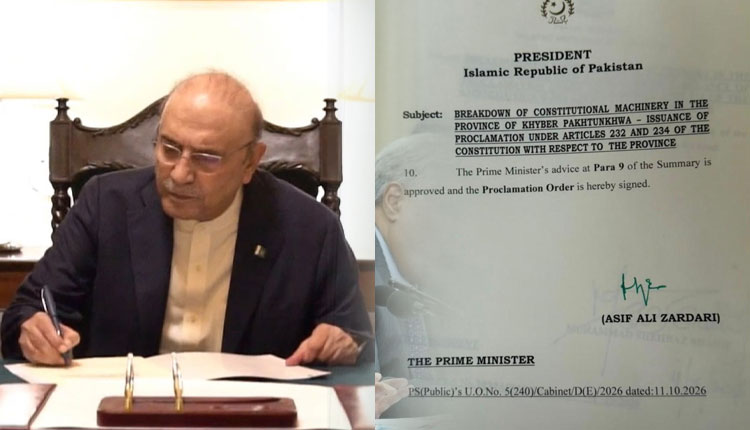
A recent example, according to the writer, is the simultaneous application of Articles 232 and 234 in Khyber Pakhtunkhwa. The circumstances cited in support of this position are as follows: the provincial Chief Minister has been leading a movement for the release of his leader, Imran Khan, whereas the Chief Minister’s primary responsibility is to administer the province rather than lead a political campaign.
The writer argues that campaigning for a political leader’s release is a fundamental right of that leader’s party, but the party itself should conduct the movement rather than the government. At most, the government could have facilitated the party’s movement, even informally or off the record. The government’s primary constitutional responsibility, however, was to run the administration, cooperate with security institutions against terrorism, restore law and order, undertake development projects and focus on providing employment to the public.
In contrast, according to a federal report cited by the writer, the provincial government remained occupied with a political movement and staged sit-ins in various districts of the province in the form of processions. The writer claims that this not only disrupted normal economic and daily activities but also coincided with a sharp increase in terrorist attacks, resulting in the deaths of hundreds of innocent citizens. The writer further alleges that the provincial government failed to heed repeated warnings from the federal government.
As a result, according to the article’s account, the President of Pakistan, on the advice of the Prime Minister, invoked Articles 232 and 234 in Khyber Pakhtunkhwa, imposing an emergency and Governor’s Rule in the province. The article concludes by stating that approval was obtained from a joint sitting of Parliament.