 Lahore 31°C
 Islamabad 28°C
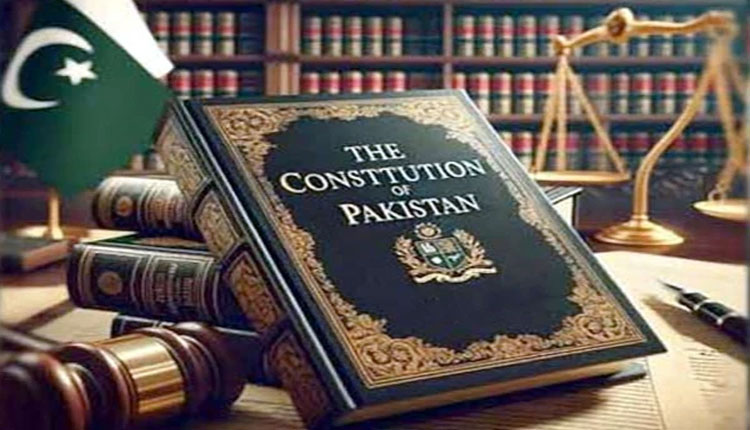
A former article of Pakistan’s Constitution, which was used by dictators to dismiss governments at their will and on their slightest whim, has supposedly been removed from the Constitution. However, Article 58(2)(b) remains alive in one form or another even today. In other words, the real source of power is not the people but an individual who, whenever angered, can easily throw an elected prime minister or chief minister out of the Prime Minister’s Office and House, despite having been elected through public votes and commanding a majority in the legislature.
During the era of Article 58(2)(b), this power was exercised through the President of Pakistan. The provision was inserted into the Constitution by military dictator General Zia-ul-Haq, who later used it himself as President. Its first major victim was Prime Minister Muhammad Khan Junejo, regarded as an honest and decent yet exceptionally bold leader. His only unforgivable offence was ordering an investigation into the blast at a secret arms depot, commonly known as Ojhri Camp, located near Faizabad on Murree Road in Rawalpindi.
As a result of the explosion, thousands of residents of the twin cities of Rawalpindi and Islamabad were killed, injured or went missing. Following the blast, leftover missiles from the Afghan war, which had been stored so secretly at the depot that nobody except those responsible for keeping them there knew of their existence, began raining down on citizens' homes, offices, heads and vehicles like raindrops. Here, the comparison with raindrops is not meant to suggest anything harmless, but rather to describe the enormous quantity of missiles. Anyway, this is a separate story, the details of which will be discussed in another article.
However, an investigation into this serious and mysterious tragedy was necessary, and the then prime minister had even announced one. But those who consider this country their own did not want such an investigation. Consequently, when Prime Minister Muhammad Khan Junejo departed on a foreign visit, he was struck with the blow of Article 58(2)(b). The man who was Prime Minister of Pakistan when he boarded the aircraft was received in the host country as a former prime minister. To justify the application of this constitutional provision, allegations of incompetence and failure were levelled against Prime Minister Muhammad Khan Junejo, while his actual offence was the announcement of an investigation into the Ojhri Camp tragedy.
The same constitutional provision was later used against the governments of Nawaz Sharif and Benazir Bhutto, cutting their tenures short to barely one and a half or two and a half years, much like a strict father using his shoe against his son. Those who controlled the use of this provision had such a strong grip on the system that, in Benazir's case, the power was exercised through her own party's president, Farooq Ahmed Khan Leghari, who had been regarded as one of the party's most loyal and respected members. Apart from giving Farooq Leghari the title of "Farigh Leghari", Benazir Bhutto could do little else. Those were the days when ethics and tolerance still existed. Unlike today, abusive language was not the norm; there were disagreements, but even those remained within the bounds of the law.
Those who fell victim to this law decided to abolish it. Through a parliamentary majority, they amended the Constitution and removed the provision, believing that their governments' tenure was now secure for the full five-year term guaranteed by the Constitution.
However, the architects of the Constitution forgot to close the loopholes that would continue to haunt them in the future, like snakes hidden in those openings waiting to strike again. One such loophole was Articles 62 and 63 of the Constitution, which established the principles of being "Sadiq and Ameen" (truthful and honest). In other words, it was essential for a prime minister to be truthful, not conceal facts and demonstrate integrity to qualify for office.
Consequently, Prime Minister Nawaz Sharif, who was a director in his son's company but did not receive any salary from his son, was disqualified for this very reason. He was declared ineligible because he had not declared in his election papers the amount that he was not receiving from his son. This historic and philosophical constitutional verdict was delivered by a full bench headed by Justice Asif Saeed Khosa, sending Nawaz Sharif from Islamabad to Lahore via GT Road. Throughout his journey, Nawaz Sharif kept asking the same question: "Why was I removed?"
Prime Minister Yousaf Raza Gilani had not violated Articles 62 and 63, but he fell victim to another constitutional loophole: contempt of court. He could not comply with the court's order directing him, as prime minister, to write a letter to the Swiss government informing it that the sitting president of his country was corrupt. For disobeying the court's order, he was summoned and sentenced to imprisonment until the rising of the court. The court announced the sentence and adjourned within just 30 seconds, immediately putting the punishment into effect. As a result, the prime minister became a convicted person and was disqualified.
Then came Imran Khan, the people's favourite prime minister and the darling of those who had brought him to power by holding his hand. He was also considered "Sadiq and Ameen" and did not disobey court orders, but he was stubborn. His stubbornness led to his removal through a no-confidence motion after his own allies were separated from him. He was removed from the Prime Minister's House and eventually sent to jail, but his defiance remains unchanged.
It is not that the Constitution has no loopholes left. Two more loopholes, Articles 232 and 234, have recently been discovered. However, their use required the ladder of terrorism in the province, something we did not have to borrow from anyone because it was already available to us. So, the point is simple: the two Articles were different, but the outcome was the same. The Chief Minister of Khyber Pakhtunkhwa did not merely lose power; he disappeared from the political scene altogether. And now his party, instead of focusing on the release of its founding leader, is busy searching for its former chief minister.