 Lahore 21°C
 Karachi 28°C
A series of articles examining the reasons, objectives and consequences behind the imposition of four martial laws in Pakistan is being launched. This is a history with which today’s younger generation is largely unfamiliar. Through this series of articles, readers will have the opportunity to become familiar with several dark and lesser-known aspects of Pakistan’s history.
Field Marshal Ayub Khan imposed Pakistan’s first martial law on 7 October 1958, fundamentally changing the country’s political foundations and giving Pakistan’s military establishment the status of the supreme authority, whereas under the Constitution, the actual responsibility of the military institution is to protect the country’s borders.
However, it is also a fact that before this martial law, political stability had already disappeared from the country. During the 1950s, governments were changing so frequently that India’s Prime Minister Jawaharlal Nehru even got the opportunity to make the sarcastic remark that he did not change his dhoti as frequently as governments changed in Pakistan.
Political parties had become divided among themselves, and a struggle over authority had begun between the government and the administration.
At that time, the government formulated Pakistan’s first Constitution in 1956, under which Pakistan was declared an Islamic parliamentary state. However, this Constitution also failed to provide political stability to Pakistan.
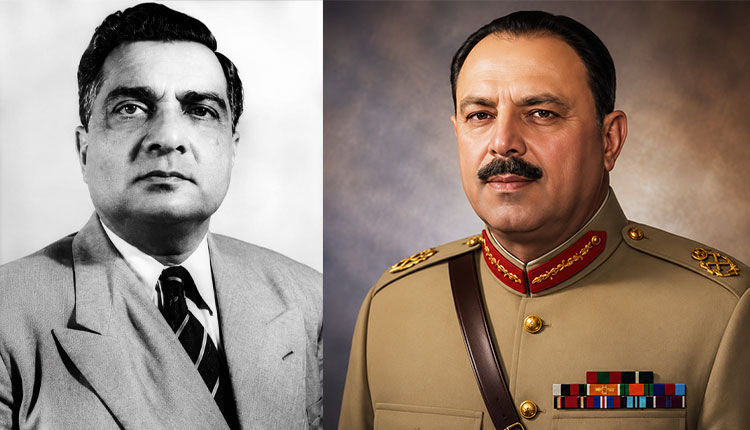
The then President, Iskander Mirza, had become deeply disappointed with the parliamentary system. He decided to end the constitutional system and, on 7 October 1958, abrogated the 1956 Constitution, dissolved the National and Provincial Assemblies, imposed a ban on political parties and announced the imposition of martial law throughout the country.
He appointed Army Chief General Muhammad Ayub Khan as the Chief Martial Law Administrator.
For Pakistan, this proved to be a historic moment that changed the course of the country’s political history. It was Pakistan’s first experience of direct military rule.
Then, what happened to Iskander Mirza was much like what often happens to those who place their trust in powerful allies.
Iskander Mirza, who had dreamed of establishing a powerful presidency with complete and unrestricted authority, was removed from the presidency by Chief Martial Law Administrator General Ayub Khan just 20 days later.
On 27 October 1958, Iskander Mirza was forced to resign from the presidency. He was subsequently sent into exile and spent the rest of his life in London. Iskander Mirza died in London in 1969.
Following Iskander Mirza’s resignation, Ayub Khan assumed the presidency and became the supreme authority in the country.
Ayub Khan’s first major step was to impose strict restrictions on political parties and politicians.
He introduced the Elective Bodies Disqualification Order (EBDO).