 Lahore 18°C
ISLAMABAD: The Supreme Court of Pakistan has dismissed a jail petition filed by Habib Ullah and upheld his conviction and life imprisonment for the murder of his wife, Aqeela Bibi.
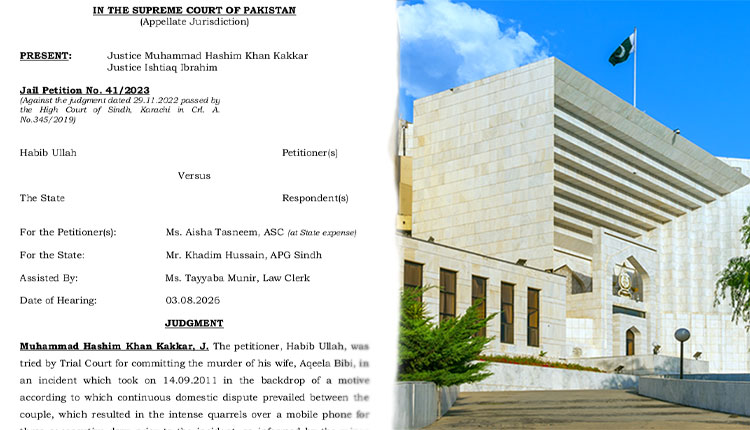
A two-member bench comprising Justice Muhammad Hashim Khan Kakkar and Justice Ishtiaq Ibrahim heard the case on August 3, 2026. The case arose from the murder of Aqeela Bibi on September 14, 2011, following a period of domestic disputes between the couple. According to the judgment, the disputes had intensified over a mobile phone during the three days preceding the incident.
Habib Ullah was convicted by the trial court under Section 302(b) of the Pakistan Penal Code and sentenced to life imprisonment. He was also ordered to pay Rs500,000 in compensation to the legal heirs of the deceased under Section 544-A of the Code of Criminal Procedure. His appeal before the Sindh High Court was dismissed on November 29, 2022, after which he approached the Supreme Court through a jail petition.
Evidence against the petitioner
The Supreme Court noted that the couple’s minor daughter, Fazeela Bibi, told the complainant about the disputes between her parents. She also stated that on the night of the incident, she saw her father bring a hammer into the house and later saw both parents enter their shared bedroom.
The following morning, the children found their mother dead on the floor with severe injuries to her head, while the petitioner was no longer present.
The post-mortem examination conducted by Dr Zakia Khursheed found fatal skull fractures caused by a heavy, hard and blunt object. The court observed that the injuries were consistent with an assault involving a hammer.
The court also took into account the petitioner’s conduct after the incident. Instead of informing the police, seeking medical assistance or informing the deceased’s family, he allegedly left the house, abandoned his four children and did not attend his wife’s final rites. He remained absconding for nearly seven years before being arrested on February 26, 2018.
Supreme Court explains ‘crime of difficult proof’
The judgment contains detailed observations on domestic violence and murders committed inside the matrimonial home.
The court referred to the legal concept of a “Crime of Difficult Proof”, explaining that some offences are difficult to establish because they take place inside private homes, away from public view.
The judgment observed that perpetrators in such cases may have control over the crime scene and could potentially destroy evidence, clean the scene or attempt to portray a homicide as a suicide, accident or attack by an outsider. The court also noted that family members may be reluctant to testify against a close relative.
According to the judgment, domestic violence, including the murder of a wife inside her matrimonial home, falls within this category because direct evidence is often unavailable. The court highlighted the particular vulnerability of married women living within their husband’s family environment.
Reference to Indian legal framework
The Supreme Court also examined how other jurisdictions deal with domestic homicides.
The judgment referred to provisions of India’s Bharatiya Nyaya Sanhita, 2023 and Bharatiya Sakshya Adhiniyam, 2023, particularly in relation to dowry deaths and the evidentiary presumptions applicable in certain circumstances.
The court also referred to Indian Supreme Court precedents, including Trimukh Maroti Kirkan v. State of Maharashtra, along with other cases dealing with unnatural deaths of women inside matrimonial homes.
Pakistani law and evidentiary burden
Turning to Pakistan’s legal framework, the Supreme Court noted that there is no explicit statutory provision creating a direct presumption of guilt in all matrimonial homicide cases.
However, the court explained that Article 122 of the Qanun-e-Shahadat Order, 1984 applies where a fact is especially within the knowledge of a particular person. The judgment stated that when a wife dies an unnatural death inside the matrimonial home, the husband may be required to explain the circumstances surrounding her death.
The court further referred to Article 129 of the QSO, under which an adverse inference may be drawn from circumstances such as absconding, failure to inform authorities, abandoning minor children or avoiding the deceased’s final rites.
The judgment also relied on the principle reaffirmed in Waris Masih v. State, stating that an unnatural death of a wife inside the matrimonial home, combined with the husband’s failure to provide a plausible explanation, can become an important link in the chain of circumstantial evidence.
Court stresses balance between accused’s rights and victims’ protection
The Supreme Court acknowledged fundamental criminal-law principles, including the presumption of innocence and the rule that the prosecution bears the burden of proving guilt.
However, it warned that these safeguards should not be misused to defeat genuine claims involving victims of domestic violence and other vulnerable groups.
The court made clear that abandoning these safeguards would be dangerous, but said genuine doubt must remain distinct from circumstances where a complete chain of evidence establishes guilt.
Circumstantial evidence can establish guilt
The court said that direct evidence of events occurring inside a matrimonial home is often rare. In such circumstances, courts can consider circumstantial evidence, the “prudent man/probability” test and relevant provisions of the QSO.
The judgment stated that where the totality of proved circumstances leads a prudent person to conclude that the accused caused or abetted the death, a conviction can be sustained even without direct eyewitness testimony.
In the present case, the court found that the prosecution had established a strong chain of circumstances: the children had seen the couple together in the room, the petitioner had brought a hammer into the house, there had been recent disputes, and the petitioner subsequently disappeared without reporting the death or seeking assistance.
The court concluded that his prolonged absconding and failure to explain how his wife died inside the house provided an additional link completing the chain of evidence.
Supreme Court criticises police investigation
The bench also expressed serious concern over the investigation of the case.
According to the judgment, the investigating officer recovered a blood-stained hammer and bedsheet from the crime scene but failed to produce them before the court.
The Supreme Court described this as a serious investigative lapse, stressing that cases of domestic homicide are already difficult to prove because they occur in private settings. Police negligence or failure to preserve and present evidence can make it even more difficult to secure justice.
The court called for greater gender sensitivity in the investigation of crimes against women and referred to specialised women-led police structures operating in countries including Argentina and Brazil.
It said provincial governments should provide police officers with appropriate training to recognise and overcome gender and patriarchal biases. Investigators must identify, preserve and place all available evidence on record, while negligence by investigating officers should result in accountability.
Court suggests Domestic Homicide Reviews
The Supreme Court also referred to the Domestic Homicide Review mechanism used in the United Kingdom under the Domestic Violence, Crime and Victims Act, 2004.
The court suggested that a similar mechanism could be considered in Pakistan to systematically examine domestic homicide cases, identify weaknesses in investigations and inter-agency coordination, and help institutions learn from previous cases.
According to the judgment, such reviews could also help lawmakers identify gaps in existing legislation and areas requiring legal reform.
Court raises concern over victim-blaming
The judgment further highlighted what it described as a disturbing tendency in cases involving violence against women: attempts to damage the victim’s character after her death in order to justify or minimise the crime.
The court observed that women may be portrayed as immoral or of bad character after being killed, shifting attention away from the alleged criminal conduct of the perpetrator.
It said such attitudes reflect deeply rooted patriarchal thinking and warned that prejudice can also affect the criminal justice system if the circumstances surrounding a woman’s death are not investigated with the seriousness they deserve.
HRCP figures cited in judgment
The Supreme Court also cited figures from the Human Rights Commission of Pakistan’s State of Human Rights Report 2025.
The report recorded 7,395 reported cases of domestic violence across Islamabad, Punjab, Khyber Pakhtunkhwa, Balochistan and Sindh, along with reported cases of honour killings, rape, acid attacks and murder. The court stressed that these figures represent only reported incidents, while many cases of violence against women remain unreported.
The court emphasised that women’s cases must be investigated and adjudicated through a gender-sensitive approach and that no perpetrator should be allowed to use allegations about a woman’s character as justification for her killing.
Supreme Court dismisses petition
After examining the evidence and the legal questions involved, the Supreme Court found no illegality, material irregularity or jurisdictional defect in the Sindh High Court’s judgment.
The bench refused leave to appeal and dismissed Habib Ullah’s petition, thereby leaving his conviction and life sentence intact .