 Lahore 16°C
 Islamabad 12°C
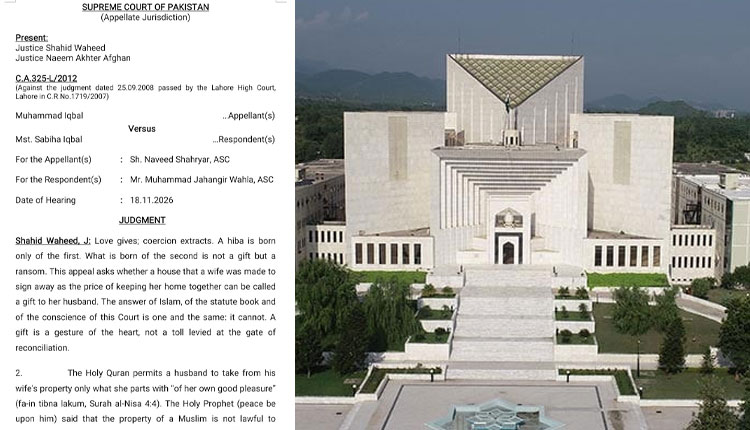
اسلام آباد: سپریم کورٹ نے قرار دیا ہے کہ شوہر اپنی بیوی سے جائیداد بطور تحفہ حاصل کرنے کا حق صرف اسی صورت میں رکھتا ہے جب بیوی اپنی آزاد مرضی اور خوشی سے جائیداد دے۔ جبر کے ذریعے حاصل کیا گیا تحفہ، تحفہ نہیں ہوتا۔
سپریم کورٹ نے اپنے فیصلے میں واضح کیا کہ ایک عورت اپنا گھر بسانے کے لیے اپنی جائیداد سے دستبردار ہونے پر مجبور نہیں کی جا سکتی اور نہ ہی صلح کے لیے اسے جائیداد بطور تحفہ دینے پر مجبور کیا جا سکتا ہے۔
یہ فیصلہ جسٹس شاہد وحید اور جسٹس نعیم اختر پر مشتمل سپریم کورٹ کے بینچ نے اہلیہ سے مبینہ طور پر جبراً تحفے میں حاصل کیے گئے مکان کے تنازع سے متعلق اپیل کی تفصیلی سماعت کے بعد جاری کیا۔
عدالت نے قرار دیا کہ قرآن کے مطابق شوہر اپنی بیوی سے وہی جائیداد بطور تحفہ حاصل کر سکتا ہے جو بیوی اپنی خوشی اور آزاد مرضی سے دے۔ جہاں تحفہ دینے والے کی آزاد مرضی شامل نہ ہو، یا پیشکش تو ہو لیکن قبولیت نہ ہو، وہاں اسے ہبہ قرار نہیں دیا جا سکتا۔
ان ریمارکس کے ساتھ سپریم کورٹ نے ذیلی عدالت کا فیصلہ برقرار رکھتے ہوئے اپیل مسترد کر دی ۔
Present:
Justice Shahid Waheed
Justice Naeem Akhter Afghan
C.A.325-L/2012
(Against the judgment dated 25.09.2008 passed by the Lahore High Court, Lahore in C.R.No.1719/2007)
Muhammad Iqbal
…Appellant(s)
Versus
Mst. Sabiha Iqbal
…Respondent(s)
For the Appellant(s
:
Sh. Naveed Shahryar, ASC
For the Respondent(s)
:
Mr. Muhammad Jahangir Wahla, ASC
Date of Hearing
:
18.11.2026
JUDGMENT
Shahid Waheed, J: Love gives; coercion extracts. A hiba is born only of the first. What is born of the second is not a gift but a ransom. This appeal asks whether a house that a wife was made to sign away as the price of keeping her home together can be called a gift to her husband. The answer of Islam, of the statute book and of the conscience of this Court is one and the same: it cannot. A gift is a gesture of the heart, not a toll levied at the gate of reconciliation.
2. The Holy Quran permits a husband to take from his wife's property only what she parts with “of her own good pleasure” (fa-in tibna lakum, Surah al-Nisa 4:4). The Holy Prophet (peace be upon him) said that the property of a Muslim is not lawful to another “except with the goodwill of his heart” (illa bi-tibi nafsin minhu). The two phrases share one root, tib al-nafs, the free and willing heart. That free heart is the soul of every hiba; where it is missing, no seal of the Sub-Registrar can put it back. On a deeper reading of the record, the appeal fails at the very first step, because the appellant never proved that he accepted the gift he now holds up as his title. A gift without acceptance is a hand held out that no one took. An offer without acceptance is a monologue, not a transaction. No court below examined the unilateral character of the deed itself, which records no acceptance at all. We do so now, and we do so on the appellant’s own case.
3. The parties were married in 1976, and two children were born of the marriage. On 11.05.1983, a plot measuring six marlas in Lahore was purchased through a registered sale deed in the name of the respondent, for Rs. 42,000/-, and Mutation No. 9263 was sanctioned in her favour on 13.06.1983. A loan of Rs. 81,000/- was sanctioned by the House Building Finance Corporation (HBFC) in her name in 1985, and a house was raised on the plot. The respondent asserts that she contributed by selling her jewellery, with help from her mother, sister, and brother. She has lived in that house, with her children, since it was built.
4. Through a gift deed registered as Document No. 3174 in the office of the Sub-Registrar, Model Town, Lahore, on 21.04.1994, the house was shown as gifted by the respondent to the appellant, and Mutation No. 20851 dated 31.05.1994 followed in his favour. In August 1998, relations broke down, and the appellant left the house. When he asserted that he was the owner and would dispossess her, the respondent made inquiries and discovered the deed and the mutation.
5. The respondent instituted a suit for declaration with consequential relief, pleading that her signatures and thumb impressions were obtained on blank stamp paper on the pretext of a power of attorney for repaying the HBFC loan, after the appellant swore on the ninety-nine names of Allah Almighty that he would not deceive her. She sought a declaration that the gift deed and the mutation were the product of fraud and ineffective against her rights.
6. The appellant's written statement is the key to this case. He pleaded that he had paid for the plot and the construction from his own pocket, so that the respondent was only a benamidar. He then pleaded that because her behaviour was not cordial, relatives intervened, and he “fixed the condition” that he would compromise with her only if she transferred the house in his name; on that agreement, the gift deed was executed.
7. The Civil Judge, Lahore dismissed the suit on 17.12.2002, reasoning that the respondent had admitted her signature, that a certified copy of a registered document is admissible in evidence, and that physical delivery of possession is unnecessary where spouses live in the same house. On appeal, the Additional District Judge, Lahore, reversed that decree on 12.06.2007. He found that the gift deed bore no marginal witness and that the space for witnesses was blank; that the identifier, one Ijaz Ahmad, was never examined; that the appellant could not even name the witnesses of his own gift; that the appellant had never sued to establish his benami claim; and that the respondent had been in possession since construction. The suit was decreed.
8. The appellant's revision application was dismissed by the Lahore High Court, Lahore on 25.09.2008. He then approached this Court. By order dated 17.05.2012, this Court granted leave to appeal to consider, inter alia, whether: “(i) the trial court had fallen into grave legal error by not framing issues based on the two basic controversies, namely, benami transaction and the gift; (ii) the respondent having admitted signatures/thumb impression on the gift deed, the onus was upon her to show that she did so due to misrepresentation by the petitioner; (iii) the deed having been registered, the burden shifted to the respondent to dislodge the execution of the gift. (iv) the respondent having no apparent source of income to purchase the plot in question or raise a house thereon, the transaction in her name was benami.”
9. At this juncture, it is necessary to delineate the approach we propose to adopt in deciding this case. The respondent challenged the gift on the plea of fraud and misrepresentation. But it is the husband, not the wife, who is the appellant before us, and it is his grievance against the decree that we are called upon to examine. We therefore examine the case from his perspective, on his own pleadings and on the evidence led by both sides, and leave the respondent’s plea of fraud and misrepresentation aside. Even on that footing, the appellant’s own stance gives us ample justification to hold that the gift was neither voluntary nor proved. In doing so, we do not decree the suit on a case the respondent did not plead; we hold only that the appellant, who set up the gift as his title, has failed to establish it on his own pleadings and evidence.
10. Before we resolve the contest, we first map the battlefield. The parties have taken divergent stances, and the case cannot be resolved without first identifying the principles of the Shariah and the provisions of the statute that governs this gift. It is therefore expedient to state, at the outset, the legal landscape within which their dispute must be decided. We begin with what the Shariah says, for in a matter of hiba, it is the Shariah that is the primary source, and the statute only its echo. A gift is a three-legged stool: declaration, acceptance and delivery of possession; remove any one leg, and it cannot stand. Islam honours the gift as an instrument of love. The Holy Prophet (peace be upon him) said: “Exchange gifts, and you will love one another” (tahadu tahabbu; al-Adab al-Mufrad). The gift is meant to knit hearts together, not to put a price on staying together. In the Farewell Sermon, the Holy Prophet (peace be upon him) declared that the property of a Muslim is not lawful to another except with the goodwill of his heart. The same principle runs through the Hanafi law of gift: a hiba is valid only when it springs from the donor’s free consent. A gift made under ikrah (coercion) is the plainest instance of its absence, but not the only one; a gift procured by pressure that overbears the donor’s will equally lacks the tib al-nafs that the Shariah requires.
11. Where the gift flows from wife to husband, the Holy Quran is especially watchful. Surah al-Nisa 4:4 allows the husband to accept what she remits only if she does so of her own good pleasure. Surah al-Nisa 4:19 forbids men to treat women harshly “that you may take away part of what you have given them.” Surah al-Nisa 4:20-21 asks: would you take it back “by slander and a manifest sin,” when you have gone in unto each other, and they have taken from you a solemn covenant (mithaqan ghaliza)? Surah al-Baqarah 2:229 and 2:231 forbid retaining a wife “to harm them” and declare that whoever does so “has wronged himself.” And Surah al-Nisa 4:32 secures to women “a share of what they have earned.”
12. The Hedaya states that a gift is rendered valid by ijab (declaration) and qabul (acceptance), and is completed by qabz (seisin, or delivery of possession). The Fatawa Alamgiri is to the same effect. Mulla's Principles of Mahomedan Law defines hiba (para 138) as a transfer of property, made immediately and without any exchange, by one person to another, and accepted by or on behalf of the latter. Para 149 lists the three essentials: (i) a declaration of gift by the donor, (ii) an acceptance of the gift, express or implied, by or on behalf of the donee, and (iii) delivery of possession of the subject of the gift. Two features of this definition decide the present appeal. First, a hiba is “without any exchange”. A transfer made in return for something, including the return of a husband to his marriage, is not a hiba at all. Second, acceptance is part of the definition itself, not an afterthought. It is the donee's answer to the donor's offer. Without it, nothing passes.
13. Having set out the Shariah, we now turn to the statutes governing the making, effectuation and proof of a gift, first among them being the Transfer of Property Act, 1882. Section 122 of the Transfer of Property Act, 1882 defines a gift as the transfer of existing property “made voluntarily and without consideration” by the donor to the donee, “and accepted by or on behalf of the donee”; such acceptance must be made during the donor's lifetime. Section 123 requires a gift of immovable property to be effected by a registered instrument signed by the donor and attested by at least two witnesses. Section 129 saves the rules of Muhammadan law, so a Muslim may make an oral gift without writing or registration. However, section 129 relaxes only the form of a Muslim gift; it does not dispense with its substance. Voluntariness, the absence of consideration and acceptance are common ground between the statute and the Shariah.
14. The architecture raised by the Transfer of Property Act, 1882 is completed by two allied statutes: the Registration Act, 1908, which governs the authentication of the instrument, and the Land Revenue Act, 1967, which governs the mutation that follows it. Section 17(1)(a) of the Registration Act, 1908 makes an instrument of gift of immovable property compulsorily registrable, and section 49 denies effect to such an instrument if it is not registered. Registration under sections 34 and 35 involves the registering officer satisfying himself about the identity of the executant and the admission of execution, and a certificate under section 60 proves that the document was registered. Registration authenticates the signature on the page; it does not breathe life into a transaction that never took place. The Land Revenue Act, 1967 completes the picture. A mutation is a fiscal record for the collection of revenue; it does not create title, and its presumption of correctness is rebuttable. A mutation is a mirror; it reflects title but cannot create it.
15. Last in this framework is the Qanun-e-Shahadat, 1984, which prescribes the mode by which a gift, when disputed, is to be proved, and the Contract Act, 1872, which defines when consent is not free. Under Articles 117 and 118 of the Qanun-e-Shahadat, 1984, the burden of proving a fact lies on the person who asserts it. Under Article 127, where one party stands to the other in a position of active confidence, the burden of proving the good faith of the transaction lies on the party in that position. Articles 17 and 79 regulate the attestation and proof of documents. Under sections 14 to 16 and 19A of the Contract Act, 1872, consent is not free where it is caused by coercion or undue influence, and a party in a position to dominate the will of another who obtains an unfair advantage must show that he did not use that position.
16. Keeping this legal framework in mind, we now move to the heart of the controversy, an appraisal of the evidence led by both sides in support of their divergent positions. Be it noted again that one hand cannot clap; one signature cannot make a gift. We have examined the certified copy of the gift deed (Exh.D.3). It is a unilateral document. It bears only the signature and thumb impression attributed to the respondent. It does not carry the signature of the appellant. Its recitals say that the respondent has gifted the house to the appellant and that henceforth he shall be its owner. Nowhere does it record that the appellant accepted the gift, or even that he was present when the offer was made.
17. The written statement says nothing about acceptance. It says that the appellant fixed a condition and that the deed was then executed. When the appellant entered the witness box as D.W.3, he again said nothing about when, where or before whom he accepted the gift. D.W.1 said nothing about the gift at all. D.W.2 said only that the gift was made at the instance of the respondent's elder sister. No marginal witness exists, because the space for marginal witnesses is blank. The identifier, Ijaz Ahmad, was not produced, and the appellant could not recall who the witnesses of his own gift were. A donee who cannot say when he accepted, where he accepted, or before whom, has not proved that he accepted at all.
18. Under Muslim law, acceptance may be express or implied. Implied acceptance is inferred from the donee's conduct: taking possession, managing the property openly as owner, receiving its rents, or asserting title to the world. None of this appears here. The respondent remained in exclusive possession throughout, as the appellant admitted in cross-examination. The utility connections remained in her name, as his own written statement concedes. The payment of property tax by a husband living in the matrimonial home is equally consistent with a husband meeting household dues; it is not an open and unequivocal assertion of ownership against his wife. He never sought to evict her, never let out the property, and never told anyone that the house was now his until the marriage collapsed four years later. Ownership that is never asserted is ownership that was never accepted.
19. The trial Court relied on the relaxation in Muslim law that formal delivery of possession is not required where spouses live together in the gifted house. That relaxation, recognised by this Court in Machhia,[1] softens only the third pillar, delivery. It does nothing for the second. The relaxation presupposes a complete and proven gift; it is a rule about how possession passes, not a substitute for acceptance. A court that dispenses with possession on the strength of cohabitation must still find that the donee accepted the gift. The trial Court never asked that question, and although the First Appellate Court noticed that the appellant had said nothing about offer, acceptance and delivery of possession, no court below examined the effect of a deed that records no acceptance at all. The burden of answering it lay squarely on the appellant, as the beneficiary of the deed whose execution the respondent denied, and this Court has repeatedly held that such a beneficiary must plead and prove each ingredient with particulars of time, place and witnesses. The appellant's pleading and evidence do not meet even the threshold of that requirement. We hold that the gift fails for want of proof of acceptance.
[1] Machhia v. Mst. Panan (1987 SCMR 2058)
20. Before we go any further, it will not be amiss if we state the difference between a sale deed and a gift deed. A sale deed records a bargain; a gift deed records a grace. The bargain proves itself by its price; the grace must be proved by its acceptance. The distinction explains why an unsigned acceptance may not trouble a sale but is fatal to a gift. Under section 54 of the Transfer of Property Act, 1882, a sale is a transfer of ownership in exchange for a price paid or promised. It is bilateral by its nature. The vendee's assent is embodied in the price he pays; the consideration is itself the badge of acceptance. That is why a sale deed is valid although, in common conveyancing practice, it is signed only by the vendor. Title passes on registration, and section 47 of the Registration Act makes the deed operate from the time it would have operated had no registration been required. A gift is the reverse of a sale in every material respect. In a sale, consideration is essential; a pure hiba is made “without consideration” and “without any exchange”. In a sale, the transferee's assent is inherent in the price he pays; in a hiba, there is no price to speak for the donee, so his acceptance must be independently proved as a separate pillar. In a sale, the deed is itself the conveyance; under Muslim law, a gift deed merely records a past transaction, the hiba itself consisting of declaration, acceptance and delivery of possession. A sale of immovable property of the value of Rs. 100 and above must be made by registered instrument, whereas a Muslim's hiba requires neither writing nor registration (section 129 of the Transfer of Property Act); and though a gift deed, if made, is registrable under section 17 of the Registration Act, registration cannot complete a gift that is incomplete. Muslim law does recognise an intermediate form, the hiba-bil-iwaz, or gift for an exchange, and its variant, the hiba-ba-shart-ul-iwaz, a gift made on the stipulation of a return. But the jurists and the courts have consistently treated the hiba-bil-iwaz as, in substance, a sale: it requires the actual payment of the iwaz by the donee, a bona fide intention on the donor's part to divest herself of the property, and, for immovable property of the requisite value, a registered instrument, while the hiba-ba-shart-ul-iwaz becomes binding only when possession has been delivered and the iwaz actually paid. The appellant cannot shelter under either doctrine. He never pleaded a hiba-bil-iwaz; the deed recites a pure and gratuitous gift with no iwaz; and the only “return” he ever claimed was his own consent to reconcile. A husband's willingness to remain in his marriage, which the Shariah already obliges him to keep on equitable terms, is not property that can be paid over as iwaz. Even on his own case the supposed iwaz failed, for within four years he left the home and divorced her. What is called a gift but priced as a bargain is neither: it fails as a hiba for want of gratuity, and as a hiba-bil-iwaz for want of a lawful iwaz. Finally, a sale once complete is irrevocable, and coercion or undue influence makes it voidable under the Contract Act; in a gift of either kind, pressure that overbears the will, coercion strikes at the very voluntariness that is the essence of the transaction. The consequence is plain. Under Muslim law, writing and registration are not the gift; they are, at best, evidence of a gift already made. When the transaction is a hiba, the deed can only be as good as the transaction it records. A deed that records only the donor's half of the transaction records an incomplete gift unless the other half is proved aliunde, and registration of an incomplete gift is the registration of an incompleteness.
21. We are mindful that a registered document carries a presumption of truth and regularity. Under Article 129 of the Qanun-e-Shahadat, 1984, read with sections 59 and 60 of the Registration Act, 1908, the Court may presume that the registering officer's endorsements are correct and that the document was executed by the person who admitted its execution before him. That presumption is, however, rebuttable, and it extends only to what the document is; it cannot make a document into something it is not. A deed that is silent on acceptance is not void on that account alone, for acceptance may be expressed or implied and may be proved by evidence aliunde. But where, as here, the donor denies the transaction, that silence leaves the donee to prove acceptance by independent evidence. On its face, Exh.D.3 records only half of a hiba. It records only the donor's declaration. It contains no acceptance by the donee, carries no signature of the donee, and bears no marginal witness. A document that recites an offer alone is, at its highest, the record of an offer, and the presumption attaching to its registration can lift it no higher than that. A presumption of truth can vouch for the ink on the page; it cannot vouch for the half of the transaction that the page never records.
22. The peculiar circumstances of this case placed the onus squarely on the appellant. The parties were husband and wife, a relationship that may well place the husband in a position of active confidence; on the appellant’s own pleading, it did. The alleged donor was the wife, who parted with her only residence while continuing to live in it with her children. The appellant himself pleaded that the deed was the condition he imposed for reconciliation. The respondent denied that she had made any gift. The deed had no attesting witness, and the identifier was withheld. In these circumstances, Articles 117, 118 and 127 of the Qanun-e-Shahadat, 1984 required the appellant, as the beneficiary in a position of active confidence, to prove the gift and its good faith by positive evidence. The trial Court erred in placing the entire onus on the respondent and in treating registration as conclusive. It reasoned that a certified copy of a registered document is “itself admissible” and that there was “no evidence to rebut” it; in doing so, it confused admissibility with proof. Admissibility opens the door of the court to a document; it does not seat its contents on the throne of truth. We therefore hold that mere registration of the gift deed of 21.04.1994 conferred no title on the appellant, and that the mutation founded on it is a reflection of nothing.
23. We must now examine the transaction from a different vantage point, that is, whether it was an outcome of free will or a will overborne. A gift made to buy back a broken home is not a gift; it is a ransom paid in the currency of a mother's fear. The appellant's own pleading supplies the proof against him. He says that he refused to reconcile unless the respondent transferred the house to him, and that she then executed the deed. On his own case, therefore, the transfer was not “without consideration”: the consideration was his agreement to return to the marriage. A transfer made in exchange for something is not a hiba (Mulla, para 138; Transfer of Property Act, s. 122). If it was anything, it was a bargain, and a bargain whose price is the husband's willingness to remain a husband is one no court of conscience can enforce. The pleading also shows that the respondent's consent was not free. A wife with two children, faced with a husband who conditions the survival of the family on her surrender of the roof over their heads, does not exercise a free choice. She makes the choice that fear and love for her children leave her. The dignity of a woman is not a commodity to be bartered for the preservation of her marriage. Where the choice is between losing the house and losing the home, the signature is extracted, not given.
24. The relationship between husband and wife may well place the husband in a position of active confidence, and on the appellant’s own pleadings, he was in that position here. Under Article 127 of the Qanun-e-Shahadat, 1984 and section 16 of the Contract Act, 1872, the husband who takes a benefit from his wife must show that the transaction was fair, that she acted of her own free will, with full understanding and, where appropriate, with independent advice. The appellant did not attempt to discharge that burden. He did not show that the respondent understood the deed, that anyone independent advised her, or that she had any reason other than his condition to part with her only home. Consent given under such pressure does not satisfy the requirement of tib al-nafs; in the language of section 122 of the Transfer of Property Act, the transfer was not made “voluntarily”. We have reached this conclusion without resting on the respondent’s plea of fraud and misrepresentation, which we have left aside. The appellant’s own stance, read with the evidence led by both sides, is enough: on his own case the gift was not voluntary, and on the whole of the evidence it was not proved. A litigant who comes to this Court to set aside a decree must survive his own pleading; that appellant does not.
25. We now turn to the benami plea. One cannot claim to be the true owner and, in the same breath, receive the property as a gift from the ostensible one. The appellant's two pleas destroy each other. If the respondent was merely his benamidar, she had nothing to give, and he had nothing to receive; a gift from a benamidar to the real owner is a contradiction in terms. If, on the other hand, he needed a gift from her, he necessarily acknowledged that she was the owner. The law does not permit a litigant to approbate and reprobate. The benami plea was, in any case, never pursued. The tests laid down by this Court[2] are well settled: the source of the consideration, the custody of the title deeds, possession of the property, and the motive for the benami arrangement. The person who asserts benami must prove it with cogent evidence. In Ghulam Murtaza[3], a case also arising from the breakdown of a marriage, this Court cautioned that the benami principle is not attracted merely because the named owner cannot prove the source of the money; otherwise, honest and bona fide transactions would be shattered. Here the sale deed, the first mutation and the HBFC loan were all in the respondent's name; she was in possession throughout; and the appellant admitted that he never brought any proceedings to establish his alleged ownership. Purchase by a husband in his wife's name is, if anything, an expression of the intention to benefit her. What the appellant did instead tells its own story. Rather than seek a declaration from a court, he obtained the house from his wife as the condition for reconciliation. Having obtained it, he left in 1998 and divorced her. Having divorced her, he has kept her in litigation for more than a quarter of a century, from the trial Court to this Court, over the only home she and their children have known. The chronology speaks for itself; the deed in 1994, his departure from the home in 1998, and, by his own account, the divorce in 1999. He used the courtroom as he once used the reconciliation table: as a place to wear her down.
26. At the hearing, we asked the appellant, who was present in person, whether he would be satisfied if the property were directed to be transferred to his own children. He replied that he did not own the children. We record the answer with sorrow. A father's tie to his children is not a title deed that he may disown when it suits him. Under Article 128 of the Qanun-e-Shahadat, 1984, a child born during a valid marriage is conclusively the legitimate child of the husband, and the law of maintenance binds him regardless of his sentiments. The Holy Prophet (peace be upon him) said that it is sin enough for a man to neglect those whom he is bound to sustain (Sunan Abi Dawud). A man who will not leave a roof even to his own children has shown the court exactly what kind of “gift” he sought. We refer to this conduct not to decide any question of paternity or maintenance, which is not before us, but because it bears on whether the alleged gift could ever have been the free act of the respondent's heart, and on the question of costs.
27. The beneficiary of a gift carries its burden on his own shoulders; he cannot shift it to the woman he claims gave it. This Court has spoken with one voice on this question for decades. In Mst. Rasheeda Bibi[4] and Mst. Nagina Begum[5], this Court reaffirmed that a valid gift requires a declaration by the donor, acceptance by the donee and delivery of possession, each of which must be established. Where the gift deeds were registered and their execution was denied, this Court held that the beneficiary must still prove the three ingredients and that the declaration of gift and delivery of possession must be established through independent evidence.[6] In Muhammad Sarwar[7], this Court held that where a gift or gift mutation is challenged, the beneficiary must prove the original transaction, and a registered deed or a mutation does not relieve him of that burden. In Islam-ud-Din[8], this Court refused to let a purported gift defeat the rights of a woman. In Muhammad Shafi[9] and Allah Diwaya[10], a gift deed was held to be compulsorily registrable. Mst. Saadia[11] explained that a Muslim may make an oral gift, but that the donee must still establish its independent ingredients: offer, acceptance and delivery of possession, whatever document records it. That is the principle we apply: the paper is evidence of the gift, never the gift itself. On possession, Alif Khan[12] required a real delivery by which the donor divests himself of control, while Machhia accepted that where husband and wife reside together, formal delivery may be dispensed with. As we have explained, neither line of authority dispenses with acceptance.
28. In Janat Bibi[13], this Court placed on the beneficiary of a transaction with a pardanashin lady the burden of proving that she understood it and acted freely, which in Ghulam Ali[14], it refused to give effect to a woman's purported relinquishment of her property rights, treating such social pressure as contrary to the injunctions of Islam. It is now well-settled that a husband has no right over his wife's property without her consent, and that unless a married woman elects to gift, sell or otherwise dispose of her property, neither her husband nor any male relative has any right over it; that the disposition of a vulnerable woman's property must be substantially understood by her, preferably with independent advice; that bridal gifts and personal property of a wife vest absolutely in her and cannot be retained by the husband; that the beneficiaries of an alleged oral gift bear the legal burden of proving it, and that coercion, social pressure, and manipulated revenue entries cannot defeat the proprietary rights of women protected by Articles 23 and 24 of the Constitution.
29. Measured against this body of law, the appellant's case collapses. He offered no evidence of acceptance, no witness to the transaction, no independent advice to the respondent, and no assertion of ownership. All he offered was a registered paper and a mutation, and this Court has held, time and again, that neither can carry the burden that the law places on the beneficiary of a gift.
30. Across legal systems, the law of gifts asks the same question: did the giver truly mean to give, and did the receiver truly take? We refer to foreign law only to the extent that it confirms, from other traditions, principles that Islamic law settled centuries earlier. In the United Kingdom, the House of Lords in Royal Bank of Scotland[15] recognised that a wife's trust and confidence in her husband may lead her to sign away her interest in the matrimonial home, and that the law must ensure her consent is real. In the United States, the New York Court of Appeals in Gruen[16], held that a valid gift requires donative intent, delivery and acceptance, and that the proponent of the gift must prove each element by clear and convincing evidence. In Canada, the Supreme Court in Pecore[17] held that on a gratuitous transfer, the person who asserts a gift bears the burden of proving it. In Australia, the High Court in Thorne[18] set aside agreements that a woman signed under the pressure of a relationship she could not afford to lose, holding them vitiated by undue influence and unconscionable conduct; the parallel with a wife who signs away her house to save her marriage is exact. Every one of these systems protects the person who gives under the pressure of an intimate relationship and requires the person who claims a gift to prove it; Islamic law goes further still, by making acceptance a pillar of the gift and freedom of the heart its essence.
31. The home is a woman's sanctuary, not a bargaining chip; and the law that protects it is written in the Holy Quran before it is written in the Constitution. Islam made the married woman an independent owner of property fourteen centuries ago, when many legal systems of the world still merged her estate into her husband's. Her ownership did not end at marriage, and it does not end because her husband wishes to make her surrender it. The Holy Quran describes spouses as garments for one another (Surah al-Baqarah 2:187), and commands that a marriage be kept on equitable terms or ended with kindness (imsakun bi-ma'rufin aw tasrihun bi-ihsan, 2:229). It forbids husbands from forgetting graciousness between them even at parting (2:237). The Holy Prophet (peace be upon him) said: “The best of you are those who are best to their wives” (Jami' al-Tirmidhi). The appellant reversed every one of these commands. He kept the marriage on the condition of extraction and ended it without kindness. He treated the marriage as a mortgage and his wife as the security.
32. The Constitution of the Islamic Republic of Pakistan gives these values the force of supreme law. Article 2A and the Objectives Resolution enshrine the principles of democracy, freedom, equality, tolerance and social justice as enunciated by Islam. Article 4 guarantees that every person shall be dealt with in accordance with law. Article 14 makes the dignity of man inviolable; the dignity of woman is no less. Articles 23 and 24 protect the right to acquire, hold and dispose of property and forbid its deprivation save in accordance with law. Article 25 guarantees equality, and Article 25(3) permits special protection of women and children. Article 31 requires the State to enable Muslims to order their lives in accordance with Islam, and Article 35 obliges it to protect marriage, the family, the mother and the child. The Legislature has carried this mandate forward through the Enforcement of Women's Property Rights Act, 2020 and its provincial counterparts, which recognise that women are deprived of their property by coercion, fraud and pressure. A court that upheld this gift would betray every one of these commitments.
33. Literature knows this husband. In Thomas Hardy's The Mayor of Casterbridge, Michael Henchard, in a fit of drink and resentment, sells his wife Susan and their infant daughter to a stranger at a country fair for five guineas, as if they were his chattels. He spends the rest of the novel paying for that sale. The appellant did not sell his wife; he did something subtler. He made her pay him the price of staying. Henchard sold his family; the appellant made his family buy him back. In Dickens’ Oliver Twist, Mr. Bumble, told that the law presumes a wife acts under her husband’s direction, retorts that if the law supposes that, “the law is a ass”. Our law makes no such supposition; it asks whether the wife’s will was her own, and here it was not. Courts are not counting-houses that weigh only stamp papers; they are the conscience of the community. A judge who sees a registered deed must also see the woman behind it: what she was told, what she feared, and what she stood to lose.
34. When the foundation falls, the house built on it needs no separate demolition. The appellant's entire claim to the property rests on the gift deed of 21.04.1994 and the mutation that followed it. We have held that the gift was never proved: acceptance was not established, the transfer was not gratuitous, the consent was not free, and registration and mutation could not cure these defects. As to question (ii), since we have decided the case on the appellant’s own stance and not on the respondent’s plea of misrepresentation, the question whether she discharged the onus of proving misrepresentation does not arise for decision; her admission of her thumb impression did not relieve the appellant of the onus of proving the gift itself. As to question (iii), for the reasons given hereinabove, the registration of the deed did not shift to the respondent the burden of disproving a gift that the document itself does not record, and that the appellant, as the beneficiary standing in a position of active confidence, was bound to prove. With the gift goes the appellant's title, and it is unnecessary to dilate upon questions (i) and (iv). We observe only that both parties went to trial knowing that the gift was the heart of the controversy and led their entire evidence on it, so the absence of a separately worded issue caused the appellant no prejudice; and that his benami plea is self-defeating.
35. Does this appeal deserve to be dismissed without any costs? Given the circumstances stated above, our answer is no. Costs are not merely the price of losing a case; they are a balm for the wounds that a vexatious litigant inflicts. The respondent has been kept in court for over twenty-eight years over the only home she and her children have. She has been forced to defend, at four tiers of the judicial hierarchy, a title that was hers on the day she bought it. The appellant pleaded inconsistent cases, extracted the deed as the price of reconciliation, abandoned the marriage, and, before us, disowned his own children. Ordinary costs would mock the respondent's suffering. In exercise of our powers under Article 187 of the Constitution, read with section 35-A of the Code of Civil Procedure, 1908 and the Rules of this Court, we consider that exemplary costs are warranted, both as compensation to the respondent and as a warning to others who would use the courts to wear down the women they once promised to protect.
36. For the foregoing reasons, this appeal is dismissed. The judgment and decree dated 12.06.2007 of the Additional District Judge, Lahore, as maintained by the Lahore High Court through its judgment dated 25.09.2008, are upheld. The gift deed registered as Document No. 3174 dated 21.04.1994 and Mutation No. 20851 dated 31.05.1994 are declared to be without lawful authority and of no legal effect as against the respondent, who is declared the owner of the suit house, and the concerned Sub-Registrar and revenue officials shall make the necessary entries in the record accordingly. The appellant shall pay costs of Rs. 500,000/- (Rupees five hundred thousand only) to the respondent within thirty days of this judgment.
[1] Machhia v. Mst. Panan (1987 SCMR 2058)
[2] Muhammad Sajjad Hussain v. Muhammad Anwar Hussain (1991 SCMR 703), Abdul Majeed v. Amir Muhammad (2005 SCMR 577) and Mst. Asia Bibi v. Dr Asif Ali Khan (PLD 2011 SC 829)
[3] Ghulam Murtaza v. Mst. Asia Bibi (PLD 2010 SC 569)
[4] Mst. Rasheeda Bibi v. Mukhtar Ahmad (2008 SCMR 1384)
[5] Mst. Nagina Begum v. Mst. Tahzim Akhtar (2009 SCMR 623)
[6] Barkat Ali v. Muhammad Ismail (2002 SCMR 1938), Ghulam Haider v. Ghulam Rasool (2003 SCMR 1829), Muhammad Ejaz v. Mst. Khalida Awan (2010 SCMR 342), Khan Muhammad v. Muhammad Din (2010 SCMR 1351), Fareed v. Muhammad Tufail (2018 SCMR 139)
[7] Muhammad Sarwar v. Mumtaz Bibi (2020 SCMR 276)
[8] Islam-ud-Din v. Mst. Noor Jahan (2016 SCMR 986)
[9] Muhammad Shafi v. Muhammad Ishaque (1998 SCMR 1274)
[10] Allah Diwaya v. Ghulam Fatima (PLD 2008 SC 73)
[11] Mst. Saadia v. Mst. Gul Bibi (2016 SCMR 662)
[12] Alif Khan v. Mumtaz Begum (1998 SCMR 2124)
[13] Janat Bibi v. Sikandar Ali (PLD 1990 SC 642)
[14] Ghulam Ali v. Mst. Ghulam Sarwar Naqvi (PLD 1990 SC 1)
[15] Royal Bank of Scotland plc v. Etridge (No. 2) [2001] UKHL 44
[16] Gruen v. Gruen, 68 N.Y.2d 48 (1986)
[17] Pecore v. Pecore, 2007 SCC 17
[18] Thorne v. Kennedy [2017] HCA 49